
Researchers from the Hefei Institutes of Physical Science of the Chinese Academy of Sciences, in collaboration with the Shenzhen International Graduate School of Tsinghua University and Suzhou University of Technology, have developed a natural electron donor–assisted healing and targeted surface reconstruction strategy that enables the direct regeneration of degraded lithium iron phosphate (LiFePO₄) cathode materials from retired power batteries.
Their work, published in Advanced Materials, offers a low-cost, energy-efficient, and environmentally friendly alternative to traditional metallurgical recycling methods.
As the use of lithium-ion batteries in new energy vehicles continues to increase, concerns over environmental pollution and resource wastage have arisen due to the large-scale retirement of these batteries. However, conventional hydrometallurgical and pyrometallurgical recycling methods can only extract valuable metal elements, rendering them economically infeasible for LiFePO₄ cathodes. In contrast, direct regeneration technology can restore degraded cathode materials more efficiently and sustainably.
In this study, the researchers used naturally extracted tea polyphenols as electron donors. Through the synergistic effect of hydroxyl electron donors and supplemental lithium salts, they successfully converted the degraded FePO₄ phase back to LiFePO₄ and reduced harmful Li–Fe anti-site defects, fully restoring the composition and structure of the material and reconstructing rapid Li⁺ diffusion channels.
To repair the damaged or missing surface carbon layers of degraded LiFePO₄ particles, the researchers introduced an aluminum source into the regeneration process. Due to the strong binding affinity between aluminum phosphate (AlPO₄) and LiFePO₄, a targeted composite coating of amorphous AlPO₄ and Li₃PO₄ formed precisely in the damaged regions. These fast ion conductors, combined with residual carbon, rebuilt efficient dual electron-ion transport channels on the surface, thereby improving the rate performance of the regenerated cathode.
Meanwhile, partial aluminum (Al) doping in the bulk phase enhanced structural stability without reducing energy density. This effectively suppressed iron ion migration and extended the service life of the regenerated LiFePO₄ cathodes.
This work provides valuable insights into the recycling of retired power lithium-ion batteries, according to the researchers.
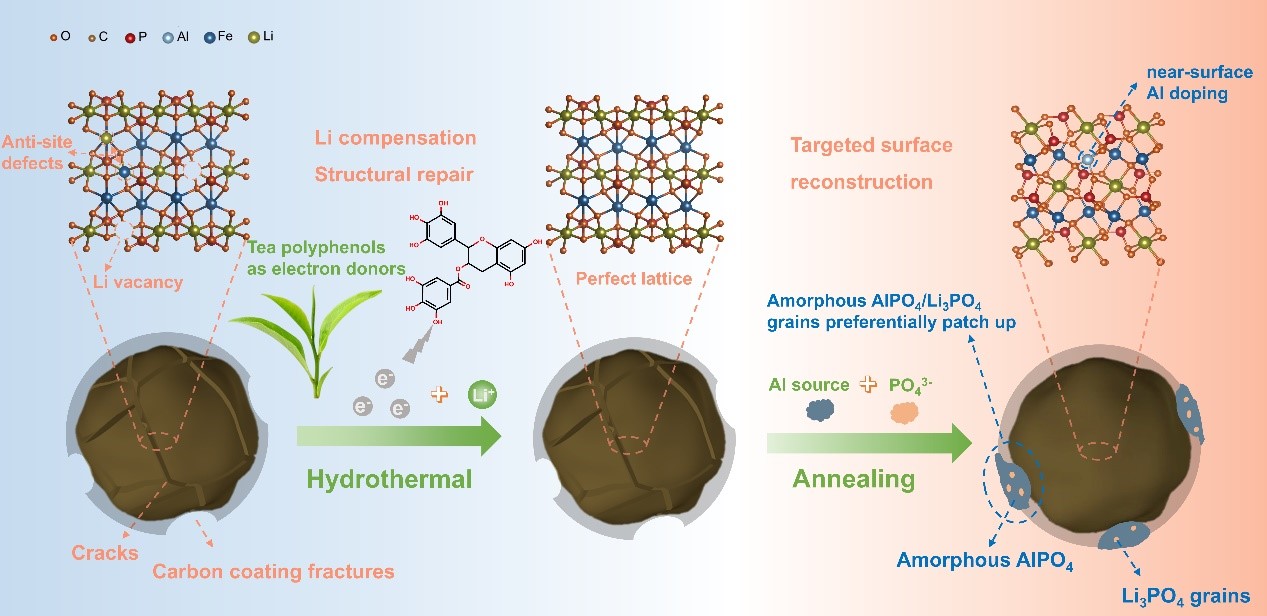
Schematic diagram of direct repair and regeneration mechanism for the retired LiFePO₄ cathodes. (Image by LIU Yuanyuan)

Electric cars seem to be an ideal option among next-generation automobiles: They are eco-friendly and accelerate fast with less noise, among other benefits. The trouble is that every 300 kilometers you may have to wait hours to refill your batteries at a charging station.
Because of sodium's high abundance, low cost, and very suitable redox potential, effort has been made to develop applicable sodium-ion batteries. The research group led by Prof. YU Yan from University of Science and Technology of China of Chinese Academy of Sciences has r...

86-10-68597521 (day)
86-10-68597289 (night)

52 Sanlihe Rd., Xicheng District,
Beijing, China (100864)
Copyright © 2002 - Chinese Academy of Sciences


